Heat pump certification: a direct response to unreliable data


One of the most persistent challenges in the heat pump market is the reliability of product data. For HVAC professionals, making the right product choice depends on accurate performance figures, yet too often declared values differ from real-world results. This creates uncertainty, undermines trust, and increases the risk of poorly performing systems.
We’ve all seen the negative headlines. In minor cases, underperformance may result in higher energy bills, but in the worst situations, a large underperformance can result in systems being unfit for purpose and replaced with more traditional, higher carbon technologies. Both situations can be avoided.
Voluntary heat pump certification has emerged as a direct market response to this problem, providing independently verified performance data that enables fair product comparison, informed decision-making, and greater confidence for specifiers, installers, and end users alike.
How voluntary certification emerged
In 1990, the European HVAC and refrigeration (HVACR) industry realised the need for an independent accreditation system to verify compliance against standards and codes. The vision of a third-party voluntary certification scheme was born, but it took several years of hard work between the industry association Eurovent, and the European Committee of Refrigeration Equipment Manufacturers (CECOMAF), to forge ahead with a plan.
In 1993 an independent legal entity called the Eurovent Certification Company was established. In 1994 certification activities commenced in earnest, with two Eurovent Certified Performance programmes available for fan coil units and air conditioning products (including air-to-air heat pumps) up to 100kW cooling capacity.
Today Eurovent Certification offers over 40 certification programmes and is majority-owned by the Eurovent association. Both have key links in the heat pump sector with the Association pivotal to building bridges between manufacturers, industry associations, legislators and standardisation bodies on a national, regional and international level.
Why do we need standardised tests?
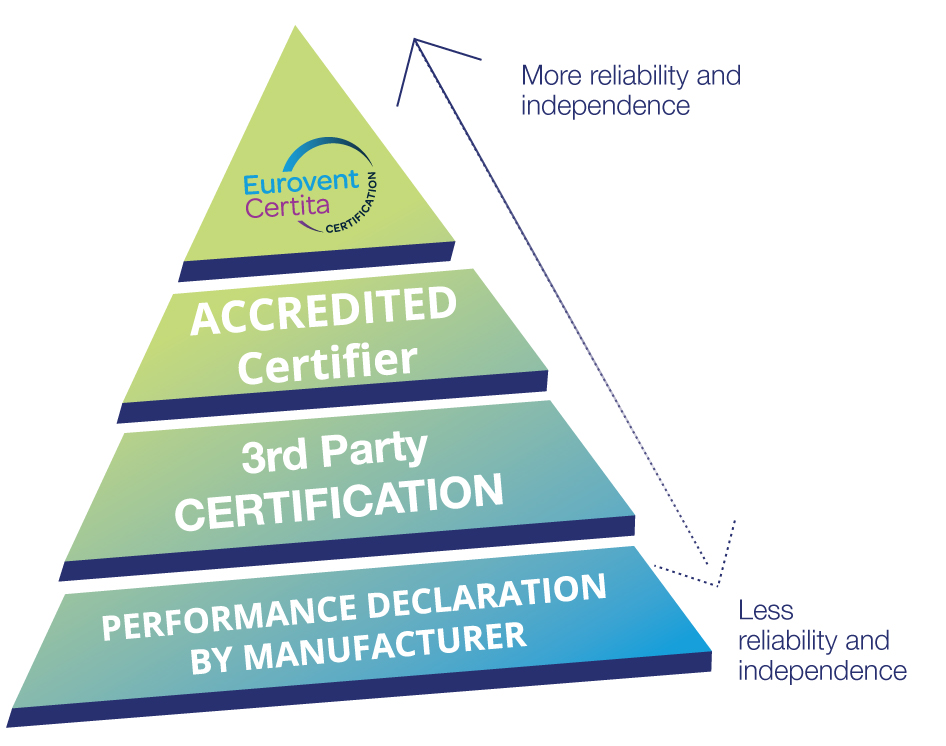
Manufacturers are not obliged to have their performance data verified independently. Some self-test and self-declare performance. Others may use an independent laboratory to test products. Further still, some go down the product certification route, opting for a more vigorous approach consisting of standardised, independent laboratory tests, factory audits, data analysis and product surveillance by an accredited certification body such as Eurovent Certification.
While self-declaration is common practice within the HVACR industry, it does raise the potential for performance metrics data (COP, SCOP, SEER, sound levels, etc.) to vary in accuracy between manufacturers.
This can be for several reasons including:
- Products may have not gone through a standardised testing process.
- Different manufacturers may have different testing set-ups. This leads to variations in testing environments, equipment, calibration or methods.
- Testing is not impartial. Bias can slip into the testing regime.
- Units may be optimised for laboratory tests, or only flagship products tested.
- Additionally, when it comes to publishing results, manufacturers may:
- Display optimised metrics e.g. using “up to” performance figures taken from ideal lab conditions, or highlighting a best-case test point
- Leave out important metrics
- Display metrics in a manner that makes data hard to extract or compare.
If manufacturers select the products to be tested, decide what tests to undertake and decide what results to publish, bias can creep in. With no independent verification from a third-party, there is no guarantee that data is accurate.
This forges an unlevel playing field for manufacturers. Products that have gone through a comprehensive, standardised process, with performance data verified by an independent third-party go head-to-head with those with unverified claims. It is down to the decision maker to decipher the data and decide what products to trust.
Impact of unverified data
Engineering firms rely on precise data for:
- Correctly sizing systems
- Meeting energy/carbon goals
- Meeting regulations
- Achieving promised comfort and cost targets for clients.
Products with unverified performance metrics can underperform, costing owners more than expected and harming the engineer’s reputation. The consequences of underperforming products include:
- Non-compliance with regulations
- Increased energy consumption and higher running costs
- Larger carbon footprint and missed sustainability goals
- Systems that are unable to meet the needs of the client
- Excess noise
- Faults – as products must work harder to meet the required capacity
- Breakdown / downtime – a real problem for any building providing a service e.g. school, hospital etc.
- Complaints, penalties and litigation.
Not all products with self-declared data will underperform. However, there is risk when selecting products that have not undergone a standardised testing process or had data independently verified.
Certification: Reducing risk
Voluntary heat pump certification directly addresses these uncertainties by requiring all certified products within a programme to undergo an identical certification process. All products:
- Are evaluated according to the same criteria
- Have results expressed in the same unit of measurement, regardless of the country where the products are manufactured or marketed
- Go through exactly the same certification, auditing and surveillance process
- Are impartiality assessed. Manufacturers and laboratories have no direct contact, keeping the process clear of any bias
- Products for laboratory testing can be taken from the production line or point of sale, ensuring the product tested is the same as those on the market
- Plus, products with components manufactured across multiple sites (sometimes in different countries), must all reach Eurovent’s certification standards.
This ensures:
- Guaranteed performance
- Accurate data
- Transparent comparison between brands
- Reduced selection errors
- Long-term energy savings and reduced emissions
- Better alignment with sustainability and compliance goals
- Traceability.
Product certification offers a standardised, unbiased process to comprehensively prove the performance of products. Specifying certified products has become a ‘de-risking mechanism’ for consultants and engineering firms. Certifications such as Eurovent Certified Performance, NF, KEYMARK and MCS are recognised in specifications, procurement criteria, and compliance documents. Engineering companies increasingly require certification as a minimum for heat pumps, ensuring traceable, comparable, and accurate performance values.
Summary table: Certification vs laboratory testing vs in-house evaluation
| In-house laboratory testing | Independent laboratory testing | Eurovent heat pump Certification programmes | |
|---|---|---|---|
| Independent from manufacturer | No | Yes | Yes |
| Manufacturer has no control of the testing process | No | Yes | Yes |
| Standardised testing procedure | No | Yes | Yes |
| Laboratories must be assessed according to ISO 17025 standard | No | No | Yes |
| Manufacturer has no direct contact with laboratory | No | No | Yes |
| Manufacturer does not select products to be tested | No | No | Yes |
| Independent factory audits to ensure production line quality | No | No | Yes |
| Free to access product database containing standardised data | No | No | Yes |
| Ongoing independent surveillance process | No | No | Yes |
Key Takeaway
Uncertain manufacturer data is a particular issue for engineering firms tasked with energy modelling, project design, and compliance in buildings. Voluntary certification transforms unverified heat pump data into a transparent, trusted resource for engineering companies, directly enabling better design, compliance, procurement, and risk reduction.
Independent certifications, such as Eurovent Certified Performance, make it possible for engineers to select products with scientifically validated performance, providing accurate data derived from rigorous laboratory testing across standardised protocols.
Engineering firms can use the Eurovent Certified Directory, a free online database, to compare certified heat pumps side-by-side, enabling data-driven selection for projects.
View Eurovent certified heat pumps now
Certification: Connecting the global HVAC network
The importance of impartiality
Are you following us on Facebook?