What's the difference between an AHU and a Hygienic AHU?


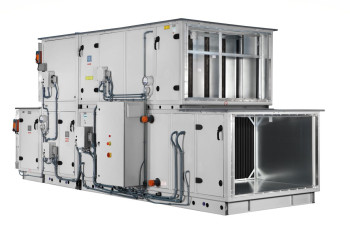
An air handling unit, or AHU, is a key part of many HVAC systems, helping to move, filter, heat, cool, and sometimes humidify or dehumidify air. While a traditional AHU is designed for general comfort applications, a hygienic AHU is built for environments where cleanliness, contamination control, and easy cleaning are essential. In our latest article we explore the similarities and key differences between hygienic and standard AHUs and look at the applications they are built for.
What makes hygienic AHUs different?
Hygienic AHUs do everything a standard AHU does, but the biggest difference is purpose. As a generalisation, a standard AHU is typically used in offices, schools, retail spaces, and other everyday buildings where the goal is comfortable indoor air. A hygienic AHU, by contrast, is intended for applications with a high hygienic standard e.g. hospitals, laboratories, cleanrooms, pharmaceutical sites, and food production areas where air quality directly affects health or product safety.
However, that’s not to say that hygienic AHUs don’t have a place in everyday buildings – increasingly businesses and schools are seeing the benefits of using hygienic units to address indoor air quality (IAQ), thus improving the indoor environment, boosting productivity and reducing sick days. As we will see, the benefits of hygienic AHUs make them a good choice for a wide range of applications.
Design and construction
Traditional AHUs usually have a straightforward internal layout and standard access panels. Hygienic AHUs are designed with smooth internal surfaces, sealed joints and easy-access cleaning points which helps reduce dust build-up and contamination risks.
Hygienic AHUs:
- Feature access to all internal surfaces
- Are constructed in such a way as to reduce places where dirt can accumulate
- Use materials that prevent fungal and bacterial growth
- Use materials that are corrosion and abrasion resistant
- Use materials that are odourless and emission free.
These features are greatly desired in environments where air purity impacts health, safety, or product quality.
Filtration and air quality
Both types of AHUs can filter air, but hygienic AHUs generally go further. Standard AHUs often use basic to medium filtration for general indoor air quality, while hygienic AHUs often include multi-stage filtration and may use HEPA-grade filters where extremely clean supply air is needed. In fact, the Eurovent Certified Performance programme for Hygienic AHUs includes minimum criteria for the number of filters and level of filtration.
Cleaning and maintenance
Hygienic AHUs are built to be easier to clean and disinfect. That matters because hidden dirt traps, rough surfaces, and hard-to-reach corners can all become problem areas in sensitive environments. Traditional AHUs do not usually need the same level of cleanability because they are not serving contamination-critical spaces.
Typical applications
A traditional AHU is a strong fit for general commercial and institutional buildings where comfort and energy performance are the main priorities. A hygienic AHU is the better choice when people, processes, or products must be protected from airborne contamination. This is why we see the hygienic AHU prevalent in operating theatres, isolation rooms, pharmaceutical manufacturing, and food processing.
Table 1: Simple comparison between AHUs and Hygienic AHUs
| Feature | Traditional AHU | Hygienic AHU |
|---|---|---|
| Main purpose | Comfort ventilation | Contamination control and clean air |
| Common use | Offices, schools, retail | Hospitals, labs, cleanrooms, pharma |
| Internal surfaces | Standard finishes | Smooth, easy-to-clean, low-retention surfaces |
| Filtration | Basic to medium | Multi-stage, often high-efficiency |
| Cleanability | Normal maintenance | Designed for thorough cleaning and disinfection |
| Cost | Lower | Higher |
However, as previously mentioned, the awareness of the benefits of good IAQ, means that hygienic AHUs are rising in demand even in general applications. Indeed, units are available that are suitable for commercial, educational, retail, fitness and hospitality projects, including hotels.
What hygienic AHU is right for your project?
Eurovent Certification has developed a 3-level system for classifying hygienic AHUs by application:
Level 1: Is suitable for commercial applications including offices, commercial buildings, schools and hotels.
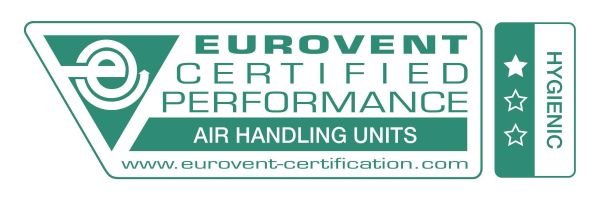
Level 2: Is suitable for use in hospitals and healthcare. Level 2 certified hygienic AHUs comply with the VDI 6022-1:2018 standard.
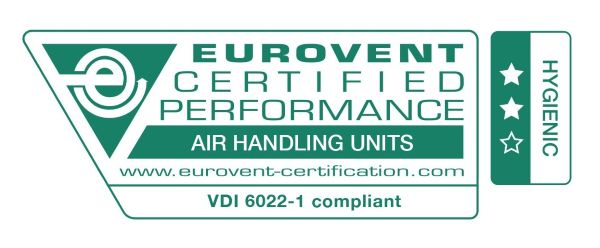
Level 3: Is suitable for applications including pharmaceutical, food processing, white rooms, operating theatres and equivalent. Level 3 certified hygienic AHUs comply with the VDI 6022-1:2018 and DIN 1946-4:2018 standards.
The 3-level classification helps decision makers identify and compare hygienic AHUs based on their use. All products certified under the Eurovent Certified Performance programme for Hygienic Air Handling Units hold the classification. Not only does this aid the decision-making process, but it also guarantees the hygienic aspect of the AHU has been independently evaluated to verify the quality of the materials used, the components selected, as well as the level of maintenance of the casing and of the components.
The hygienic certification is an optional extra for manufacturers already enrolled in the Eurovent Certified Performance programme for Air Handling Units, which means there’s also a wealth of verified data available on mechanical and performance characteristics of the unit.
Conclusion: Why the distinction between AHUs matters
Choosing the right AHU is not just a technical decision; it affects comfort, compliance, maintenance effort, and long-term performance. For many projects, a traditional AHU is perfectly suitable. But when hygiene is critical, a hygienic AHU offers the design features needed to support safer, cleaner, and more controlled indoor environments.
The bottom line is that hygienic AHUs:
- Offer improved IAQ
- Aid compliance with health and safety standards (e.g. VDI 6022-1:2018 and DIN 1946-4:2018)
- Prevent microbial growth
- Offer easier cleaning and maintenance.
Hygienic AHUs therefore offer an excellent solution in projects that demand enhanced levels of air quality and cleanliness.
Search for certified Hygienic AHUs
Discover more about the Hygienic Air Handling Unit programme
Certify Your Products

Understanding Life Cycle Assessment (LCA)
Hygienic AHUs take centre stage at CLEANFACT & RHVAC Vietnam
Are you following us on Facebook?