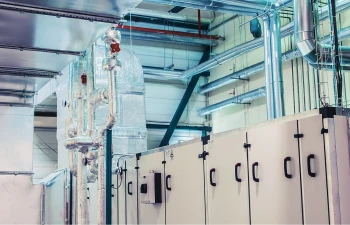
HVAC stands for heating, ventilation and air conditioning and describes the overall systems used to manage indoor comfort and air quality. An air handling unit (AHU) is equipment that moves and treats air within some HVAC systems. Depending on its configuration, an AHU can filter, heat, cool, humidify or dehumidify air and recover energy. The key difference is scope: HVAC describes the overall system, while an AHU is one possible component. Not every HVAC system includes an AHU, and not every AHU provides all HVAC functions.
HVAC is an umbrella term for heating, ventilation and air conditioning systems. On a very basic level:
Heating provides thermal comfort by ensuring indoor spaces are warm when outside temperatures are cold.
Ventilation supplies fresh outdoor air into a building or space and removes stale indoor air to help manage pollutants, odours and moisture.
Air conditioning provides thermal comfort by cooling indoor spaces when outdoor temperatures rise.
In addition, HVAC systems can provide air filtration, air purification, humidification, dehumidification and heat recovery – depending on system type and set up.
Depending on the building and system design, HVAC equipment may include:
Boilers and heat pumps
Air conditioners and chillers
Air handling units, fans and ducts
Ventilation terminals and controls
Not every installation includes all these components. The combination depends on the building’s heating, cooling and ventilation needs. Some systems require dedicated plant rooms or outdoor space, while others use compact or distributed equipment.
An AHU circulates and treats air to support indoor air quality (IAQ) and comfort. Its functions depend on the components fitted: not every unit provides every form of air treatment. Common components include the following:
Particle filters capture airborne particles such as dust, pollen and pet dander. Mechanical filters use fibrous media to retain particles as air passes through them. Standard particle filters do not generally remove gaseous pollutants or odours effectively; these require suitable gas-phase filtration, such as activated carbon or other sorbent media selected for the contaminants concerned.
Filters also help protect downstream components from particle build-up. However, filtration alone does not prevent microbial growth. Good AHU hygiene depends on appropriate design, moisture control, condensate drainage, cleaning and timely filter replacement.
Specialist applications may require dedicated extraction and contaminant-specific treatment. For example, grease-laden kitchen exhaust and hazardous workshop emissions should not be treated as ordinary building ventilation that simply needs extra AHU filters. The extraction and treatment arrangements must suit the activity and contaminants involved.
To make the filters as effective as possible, it is important to ensure that the filters are fitted as securely as possible, with no air leaking either through the case of the AHU or through gaps in the filter frame.
Outdoor air often needs heating or cooling before it is supplied to a building. Heat recovery components transfer thermal energy between the extract and supply air streams, reducing the need for additional treatment. In winter, heat from the extract air can warm incoming outdoor air. In summer, when outdoor air is hotter than the extract air, recovery can help reduce the incoming air’s cooling load.
Energy recovery alone may not achieve the required supply air temperature. Additional heating or cooling components can therefore be fitted. Finned water-to-air coils commonly connect to the building’s heating or chilled-water system. An AHU can also contain a refrigerant coil that acts as an evaporator for cooling or a condenser for heating, depending on the system’s design and operating mode.
Electric heaters are another option for heating. A cooling coil can also dehumidify the air when its surface temperature is below the air’s dew point, causing water vapour to condense. Effective moisture removal depends on coil selection, operating conditions and controls, together with suitable condensate collection and drainage.
Fans move air through the AHU and any connected ductwork, overcoming resistance from filters, coils and other components. Depending on the unit’s design and airflow requirements, a single fan or an array of fans may be used for each air stream.
Examples of centrifugal fan blade designs include:
Forward-curved
Backward-curved
Aerofoil (which can also be backward-curved)
Backward inclined
These descriptions are not mutually exclusive or an exhaustive list. Fan selection software can help identify suitable fans and configurations based on the required airflow and pressure, energy efficiency and noise levels.
Noise can be an unwanted and disturbing by-product of the AHU system. As such, they are often fitted with silencer units that reduce the noise generated by the fan, or other loud parts of the system.
Thank you so much for subscribing to our newsletter! We're thrilled to have you as one of our subscribers !
classic-newsletter-notification-error
Stay aware of all our updates by subscribing to our newsletter.
Stay aware of all our updates by subscribing to our newsletter.
Where humidity control is required, an AHU can be equipped to add or remove moisture. The target humidity range depends on the building’s use and the needs of its occupants or processes.
Humidifiers add moisture using steam or water. Dehumidification can be achieved by cooling air below its dew point so that water vapour condenses on the cooling coil and is drained away. The equipment must be designed, operated and maintained to manage moisture hygienically.
Some AHUs include a mixing section, where outdoor air and recirculated return air are combined in controlled proportions before further treatment. This can reduce heating or cooling demand, but must not compromise the required outdoor-air supply or contaminant control. Recirculation is not appropriate for every application, and some AHUs operate with 100% outdoor air.
HVAC is the umbrella term for heating, ventilation and air conditioning systems. An AHU is a specific piece of equipment that moves and treats air. It may form part of an HVAC system, alongside equipment such as heat pumps, boilers or chillers, but the two terms are not interchangeable.
No. HVAC systems can use different combinations of equipment to meet a building’s needs. Some use a central AHU to distribute treated air, while others use individual heating or cooling units with ventilation provided separately. Whether an AHU is needed depends on the building’s use, size, air quality requirements and system design.
Yes, if it is equipped with suitable heating and cooling components. For example, an AHU can use water coils connected to a heating or chilled-water system, or refrigerant coils connected to compatible equipment. However, some AHUs provide ventilation and filtration without active heating or cooling.
Eurovent Certified Performance provides independently verified product performance data within the scope of the relevant certification programme. For AHUs and other covered HVAC equipment, it provides a guarantee of performance, which helps specifiers, installers and building owners compare products and select equipment against project requirements with greater confidence in the declared data.
Need help with a certificate or certified product?
Can’t find a product, verify a certificate or understand the information provided? Send us your request and our team will help you find the right answer.