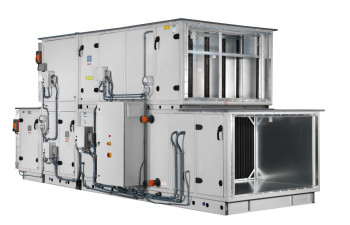
The purchase price of an air handling unit (AHU) is only one part of its true cost. Energy use, maintenance, replacement parts, installation and the effect of the unit on other building services can all have a greater financial impact over its lifetime. A life-cycle cost assessment, supported by independently verified performance data, helps specifiers compare AHUs fairly and identify the solution that offers the best long-term value.
An air handling unit supplies, extracts and conditions air in buildings. Depending on its configuration, it may filter the air and provide heating, cooling, humidification, dehumidification or heat recovery. The right AHU therefore supports indoor air quality (IAQ), occupant comfort and building energy performance.
However, these benefits come with capital and operating costs. Focusing on the lowest purchase price can lead to higher energy bills, greater maintenance requirements or inadequate performance. To understand the likely return on investment, decision makers need to assess the AHU as part of the complete ventilation and HVAC system.
Buildings are Europe’s largest energy consumer, accounting for around 40% of energy use in the EU. Ventilation, heating and cooling all contribute to this demand, so the design and operation of an AHU can significantly affect a building’s running costs and environmental impact.
AHU energy consumption depends on factors including airflow, operating hours, internal and external design conditions, pressure losses, fan and motor efficiency, filtration, heating and cooling demand, controls, and the performance of the heat recovery system. These factors interact, which means no single specification can determine the most efficient choice for every project.
Demand-controlled ventilation, effective controls, appropriate filtration and a well-designed heat recovery system can reduce consumption. Correct sizing and commissioning are equally important: an efficient product may still perform poorly if it is oversized, incorrectly configured or operated outside its intended conditions.
The initial cost of an AHU varies according to airflow capacity, casing performance, component quality, filtration, heating and cooling functions, heat or energy recovery, controls, acoustic treatment, hygiene requirements and installation constraints.
A meaningful cost comparison should include:
Purchase, delivery, installation and commissioning
Annual fan, heating, cooling and auxiliary energy use
Filter changes, cleaning, inspections and planned maintenance
Repairs and replacement components
The expected service life and residual value
Energy-price assumptions, inflation and the chosen discount rate
The impact on connected systems, such as boilers, heat pumps, chillers, pumps, ductwork and electrical infrastructure.
These inputs provide a more realistic picture than the unit price alone.
AHU selection should start with the needs of the building and its occupants. The designer should establish the required outdoor airflow, indoor air quality targets, thermal loads, climate conditions, operating schedule, available plant space, hygiene needs and acoustic limits before comparing products.
Key points to assess include:
Verified performance: compare independently verified airflow, pressure, fan power, energy recovery, casing, filtration and acoustic data.
Energy efficiency: review the complete unit configuration and expected annual consumption, rather than relying on one component value.
Pressure drop: minimise unnecessary resistance across filters, coils, dampers, energy recovery devices and duct connections while maintaining the required air quality and performance.
Part-load operation: consider how the AHU will operate during typical conditions, not only at the design point.
Sound performance: check sound power data by octave band where acoustics are critical and account for any additional pressure loss from attenuation measures.
Moisture management: design drainage, insulation and controls to avoid uncontrolled condensation and microbial growth.
Weather protection: locate and design outdoor air intakes and exhausts to limit rain, snow, debris, pests and short-circuiting between exhaust and intake air.
Maintainability: allow safe access for inspection, cleaning, filter replacement and component servicing.
Product selection depends on the accuracy of manufacturers’ declared data. Choosing an AHU with Eurovent Certified Performance gives specifiers access to independently verified performance data, the assurance selection software has also been verified and makes it easier to compare products on a consistent basis.
In addition, decision makers can view the Eurovent Certified Performance energy efficiency classification for AHUs, which runs from A+ to E. It considers key characteristics including fan efficiency, air velocity through the unit, and the efficiency and pressure drop of the heat recovery system. The most suitable class still depends on the application, climate and operating profile, but the classification provides a clear starting point for comparison.
Thank you so much for subscribing to our newsletter! We're thrilled to have you as one of our subscribers !
classic-newsletter-notification-error
Stay aware of all our updates by subscribing to our newsletter.
Stay aware of all our updates by subscribing to our newsletter.
Return on investment cannot be calculated from the purchase price alone. A higher-performing AHU may cost more initially but reduce annual energy use, maintenance costs or the required capacity of connected heating and cooling equipment.
A simple payback calculation divides the additional investment by the expected annual saving. This can be useful as an initial check, but it does not account for changes in energy prices, future maintenance, component replacement or the time value of money.
For a more complete comparison, use a life-cycle cost (LCC) or total cost of ownership assessment. Eurovent Recommendation 6/19-1: Life Cycle Cost calculation for AHUs provides a standardised methodology for estimating annual energy consumption and associated costs. Using consistent assumptions for each option helps avoid misleading comparisons.
An AHU life-cycle cost assessment should normally consider:
Capital, installation and commissioning costs
Annual energy consumption under representative climate and operating conditions
Planned maintenance, cleaning and filter replacement
Repairs and replacement of components during the assessment period
Service life, residual value and disposal costs where relevant
Energy-price escalation, inflation and discount rate
Interactions with other building systems.
The assumptions and calculation period should be stated clearly. Results are forecasts, not guarantees, so sensitivity analysis can show how changes in operating hours, energy prices or maintenance costs affect the preferred option.
The best-value AHU is not necessarily the cheapest or the unit with the highest energy class in isolation. It is the solution that meets the project’s ventilation, comfort, hygiene and acoustic requirements at the lowest realistic lifetime cost.
For example, an effective heat recovery system may reduce heating and cooling demand and allow connected plant to be sized differently. Larger casing dimensions may lower air velocity and fan energy, but require more plant-room space. Higher-grade filtration can improve air cleanliness, while increasing pressure drop and filter costs if it is not properly selected and maintained.
These trade-offs should be evaluated at system level. Early collaboration between the designer, manufacturer, installer, controls specialist and building operator can help ensure that the selected AHU achieves its intended performance in practice.
An AHU is a long-term investment in indoor air quality, comfort and building performance. To calculate its return on investment, compare capital expenditure with the energy, maintenance and system costs expected throughout its service life.
Accurate, independently verified performance data makes this assessment more reliable. By combining certified data with project-specific life-cycle cost analysis, decision makers can select an AHU that delivers the required performance and better long-term value.
Energy is often a major lifetime cost, but the balance varies by application. Fan electricity, heating, cooling, filtration, maintenance and operating hours should all be included in the assessment.
No. Price alone does not prove efficiency or suitability. Compare verified performance data, annual energy calculations, maintenance needs and whole-life costs for the actual project conditions.
It is a classification from A+ to E based on certified performance data and key factors such as fan efficiency, air velocity, and heat recovery efficiency and pressure drop. It supports product comparison but should be considered alongside the building’s design and operating profile.
A simple calculation divides the additional capital cost by expected annual savings. A life-cycle cost assessment provides a fuller picture by including energy, maintenance, replacement, financing assumptions and interactions with other HVAC equipment.