
Indoor air quality: How can the performance of a ventilation system be assessed?


With the ECP IAQVS certification programme, Eurovent Certita Certification transforms CO₂, humidity and formaldehyde into comparable performance indicators.
High-performance ventilation is not simply a matter of airflow or electricity consumption. It must also be capable of maintaining, under realistic conditions of use, an indoor environment that is favourable to both the occupants and the building.
But how can this performance be objectively assessed?
To mark World Ventil8 Day, Eurovent Certita Certification revisits the approach developed in the IAQVS programme. This programme jointly assesses the indoor air quality and the energy performance of complete residential ventilation systems, based on simulations that take into account the characteristics of the dwelling, its occupancy and the climate.
Indoor air quality (IAQ) has become a major issue for public health and building performance. As we spend nearly 80 per cent of our time indoors, requirements are evolving rapidly, driven by a combination of health expectations, public policy and the energy transition.
In this context, a key question arises for those in the building sector: how can we simultaneously ensure good indoor air quality and optimal energy performance of ventilation systems?
The Eurovent Certified Performance IAQVS certification provides a structured method for assessing this dual performance, based on an analysis of the ventilation system as a whole.
Moving from a prescriptive requirements-based approach to a performance-based approach
Historically, building ventilation has relied primarily on a means-based approach, founded on compliance with prescriptive requirements such as air flow rates or specific technical configurations. However, this approach does not always guarantee the expected performance under representative conditions of use.
Recent regulatory developments, particularly at European level (the EPBD Directive), are ushering in a transition towards a more performance-based approach, incorporating indoor environmental quality (IEQ) indicators, of which IAQ is a key pillar.
In this context, IAQVS certification is fully in line with this trend by offering an assessment based on measurable and comparable results.
An innovative approach: assessing the performance of the entire system
Unlike traditional component-centred approaches, IAQVS certification is based on a comprehensive analysis of the ventilation system.
It takes into account:
- ventilation units
- ductwork
- air inlets and outlets
- conditions of use.
The aim is to answer a key question: What is the expected performance of the system in a given dwelling, under realistic conditions of use?
This approach makes it possible to:
- compare solutions with equivalent configurations
- identify the highest-performing systems according to the context
- optimise the balance between air quality and energy consumption.
A robust methodology based on simulations
At the heart of the IAQVS certification lies an advanced simulation methodology.
Each system is assessed through thousands of iterations simulating realistic scenarios:
- housing types (from F1 to F6)
- climatic conditions (temperate, cold, hot)
- occupancy behaviours (cooking, showering, laundry)
- building characteristics (orientation, ventilation, etc.)
These simulations provide results that reflect performance under realistic usage conditions.
The calculations are carried out until the indicators converge, ensuring the robustness of the results.
Multi-criteria IAQ indicators
The assessment of indoor air quality is based on several complementary indicators, reflecting the main health and comfort concerns.
CO₂: an indicator of air confinement and air exchange
The CO₂ indicator is directly linked to human occupancy. It assesses the frequency and severity of episodes of air confinement during the simulations.
High concentrations can lead to fatigue, headaches, irritation, etc.
The index used is based on the frequency with which concentration thresholds are exceeded, reflecting the level of air confinement.
|
IAQ level |
Frequency of CO₂ concentrations in the air |
|
|
5 |
100% of CO₂ readings < 1000 ppm |
air with little or no confinement |
|
4 |
1/3 of readings > 1000 ppm but < 1700 ppm |
|
|
3 |
2/3 of readings > 1,000 ppm but < 1,700 ppm |
moderate confinement
|
|
2 |
2/3 of readings > 1,000 ppm, of which 1/3 > 1,700 ppm |
|
|
1 |
2/3 of the readings > 1,700 ppm |
High containment, insufficient ventilation
|
|
0 |
100% of CO₂ readings > 1,700 ppm |
The longer the system maintains concentrations within the most favourable ranges, the better its rating. Conversely, a low rating indicates more frequent or more significant exceedances, reflecting insufficient air exchange relative to the simulated occupancy.
Relative humidity: a health and building performance issue
Relative humidity is strongly influenced by human activities (cooking, showering, laundry).
It plays a central role in occupant comfort and in the sustainability of the building.
Air that is too dry causes discomfort for occupants, with a risk of irritation to the eyes, nose, throat and respiratory tract.
Excessively high levels encourage mould growth, bacterial proliferation and damage to the building structure.
The indicator is not based on a single measurement, but on the analysis of thousands of simulated situations incorporating different climates, dwellings and occupancy scenarios; it takes into account the distribution of values across different humidity ranges, with particular attention paid to critical situations.
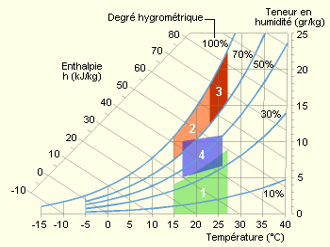
Fauconnier diagram and hygrothermal comfort zone.
The Fauconnier diagram plots the relationship between air temperature and relative humidity. Polygon 4 represents the desired hygrothermal comfort zone. The longer the simulated conditions remain within this polygon, the better the combined control of temperature and humidity, whilst reducing situations conducive to discomfort or damp-related problems.
The IAQVS approach aims to measure the ability of ventilation systems to maintain dwellings within this comfort zone over the long term.
Formaldehyde: a priority indoor air pollutant
Formaldehyde is a volatile organic compound frequently found in indoor air.
It can be emitted by numerous sources present in dwellings, including certain building materials, finishes, furniture and interior design products.
Exposure to formaldehyde can cause various health effects. In the short term, it is likely to lead to irritation of the eyes, skin or respiratory tract, as well as allergic reactions in certain sensitive individuals. In the longer term, repeated exposure to high concentrations can lead to more serious respiratory effects and is associated with a recognised carcinogenic risk.
The assessment is based on two complementary indicators. The first characterises long-term exposure based on the average concentrations obtained during the simulations. The second assesses short-term episodes, taking into account the frequency with which levels exceed 100 µg/m³. The average of the two scores is then used to characterise the system’s overall performance with regard to formaldehyde.
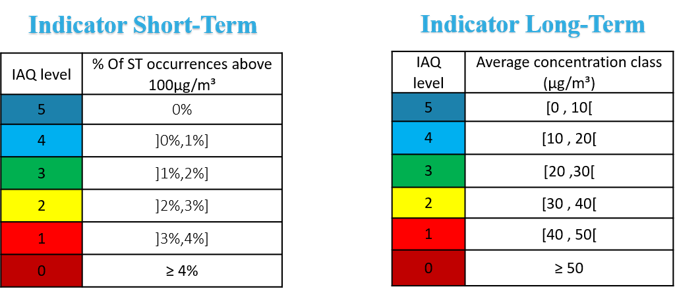
The formaldehyde indicator combines an assessment of chronic exposure, based on average concentrations, with an assessment of occasional peaks. A high score reflects the system’s greater ability to maintain low concentrations and limit adverse episodes.
A cross-analysis: IAQ and energy performance
One of the major contributions of IAQVS is to cross-analyse air quality indicators with those of energy performance through heat losses associated with air exchange and the electricity consumption of the systems.
This approach helps to avoid optimisations at the expense of IAQ and promotes a balanced approach.
A response to current and future challenges
At a time when regulations are evolving towards more comprehensive requirements regarding indoor environmental quality, assessment tools must adapt.
IAQVS provides a structured response to these challenges by:
- incorporating the key IAQ indicators
- offering a robust and reproducible method
- providing a clear overview of performance.
Ultimately, this type of approach could become a key element of construction and renovation policies, particularly in the context of carbon neutrality and quality of life objectives in buildings.
Conclusion
IAQVS certification marks a significant development in the way building ventilation is assessed.
By shifting from a prescriptive approach to a performance-based one, and by incorporating a systemic view of indoor air quality, it provides industry stakeholders with a robust, comparable and operational tool.
Against a backdrop of transformation in the construction sector, it helps to bring together health requirements, energy performance and actual usage – three pillars that are now inextricably linked.
Find out more about the IAQVS programme
Need help with a certificate or certified product?